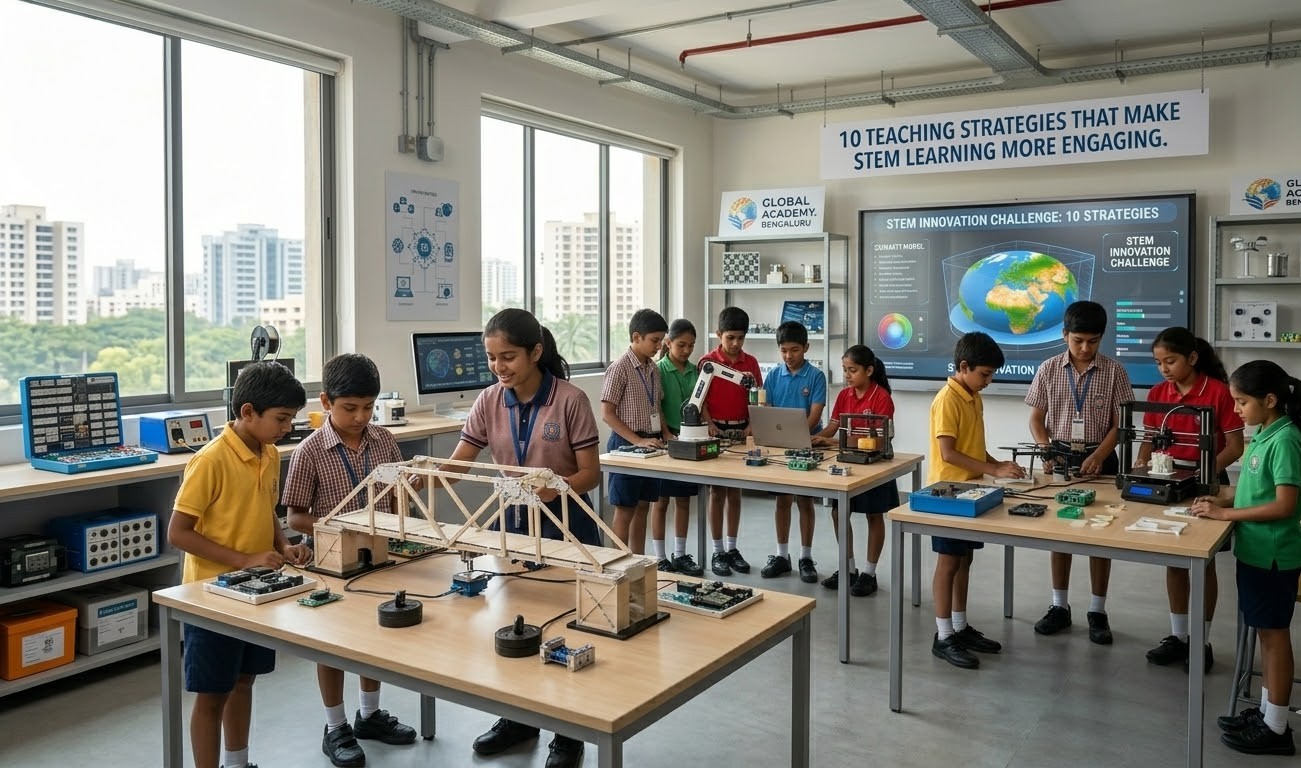
Many teachers face a common challenge in science classrooms: how to keep students engaged. Science is naturally exciting. It explains how the world works�why rain falls, how electricity powers our homes, how plants grow, and how technology changes our lives. Yet in many classrooms, science becomes a subject that students memorize rather than explore.
The reason is simple. Traditional teaching methods often focus heavily on textbooks and lectures, leaving little room for curiosity and exploration. But today's classrooms are changing. Schools across the world are adopting new teaching approaches that encourage active learning. STEM education is at the heart of this shift.
While hands-on experiments are an important part of STEM learning, teachers can also use many other creative teaching strategies to make science meaningful and engaging. These strategies help students observe, discuss, design, and solve problems, both inside and outside the classroom. Here are ten powerful teaching strategies that can transform science learning into an exciting experience for students.
1. Project-Based Learning
One of the most effective ways to teach STEM is through project-based learning. Instead of simply explaining a concept, teachers can challenge students to solve a real-world problem. For example: How can we design a system to save water in our school? How can we create a simple wind turbine model? How can we build a bridge that can hold weight? Students work in teams, research ideas, build prototypes, and present their solutions.
2. Outdoor Science Walks
Sometimes the best science classroom is outside the school building. Nature itself is a laboratory. Teachers can take students on science walks around the school campus or nearby parks. During these walks, students observe different types of plants, insects, weather patterns, and soil conditions. Outdoor science walks help students understand that science exists everywhere, not just in textbooks.
3. Design Thinking Challenges
Design thinking is a teaching approach where students identify a problem and create solutions. Teachers can introduce simple design challenges such as building a tower using paper and tape or creating a device that protects an egg from breaking. These challenges encourage students to test ideas, improve designs, and learn from failure.
4. Science Debates and Discussions
Science is not only about experiments�it also involves discussion and reasoning. Teachers can organize classroom debates on topics like "Should plastic be banned?" or "Are electric cars better for the environment?" This method help students develop communication skills and evidence-based reasoning, turning the classroom into an interactive learning environment.
5. Model Making Activities
Building models is a powerful way for students to understand complex concepts. Teachers can ask students to create models of the solar system, a volcano, or a windmill. These activities integrate art and creativity with science learning, allowing students to visualize how systems work.
6. Role Play and Simulation
Role play can make science lessons surprisingly engaging. Teachers can create classroom simulations where students act as environmental scientists, engineers, or doctors. Through role play, students learn to think from different perspectives and connect emotionally with scientific ideas.
7. STEM Storytelling
Stories are one of the most powerful teaching tools. Teachers can introduce science concepts through stories about famous scientists like Newton or Marie Curie. Storytelling captures students' imagination and makes learning memorable, especially when imagining future scenarios like traveling to Mars.
8. Data Collection Activities
Students enjoy collecting and analyzing real data. Teachers can assign simple activities such as recording daily temperature or measuring rainfall. Students learn how scientists collect information and analyze patterns, introducing them to the core of scientific observation.
9. Technology-Based Learning
Technology can enhance STEM learning when used thoughtfully. Teachers can introduce tools such as science simulations, educational videos, and virtual labs. These tools help explain concepts that may be difficult to demonstrate physically, such as how atoms interact or how ecosystems function.
10. Innovation Clubs and STEM Communities
Some schools create innovation clubs where students can explore science beyond the classroom. These clubs allow students to work on creative projects, participate in science fairs, and build robotics models. Innovation clubs help schools build a culture of curiosity and experimentation.
The Role of Teachers in Modern STEM Education
In today's classrooms, the teacher's role is evolving. Teachers are no longer just providers of information; they are facilitators of discovery. By introducing creative teaching strategies, teachers help students ask questions, explore ideas, and develop solutions through experience. This shift from passive learning to active learning is the foundation of STEM education.
How ScienceUtsav Supports Innovative STEM Learning
At ScienceUtsav, we believe that science learning should be interactive, engaging, and inspiring. Our programs help schools implement STEM education through hands-on STEM kits, structured activity modules, robotics programs, and teacher training workshops. These resources make it easier for teachers to introduce creative teaching methods in the classroom.
Conclusion
Science education becomes powerful when students move beyond memorizing facts and begin to explore, question, and create. By using a variety of teaching strategies�such as project-based learning, outdoor exploration, and storytelling�teachers can transform their classrooms into spaces of discovery. As education continues to evolve, schools that embrace innovative STEM teaching approaches will be better prepared to nurture the thinkers and problem-solvers of tomorrow.