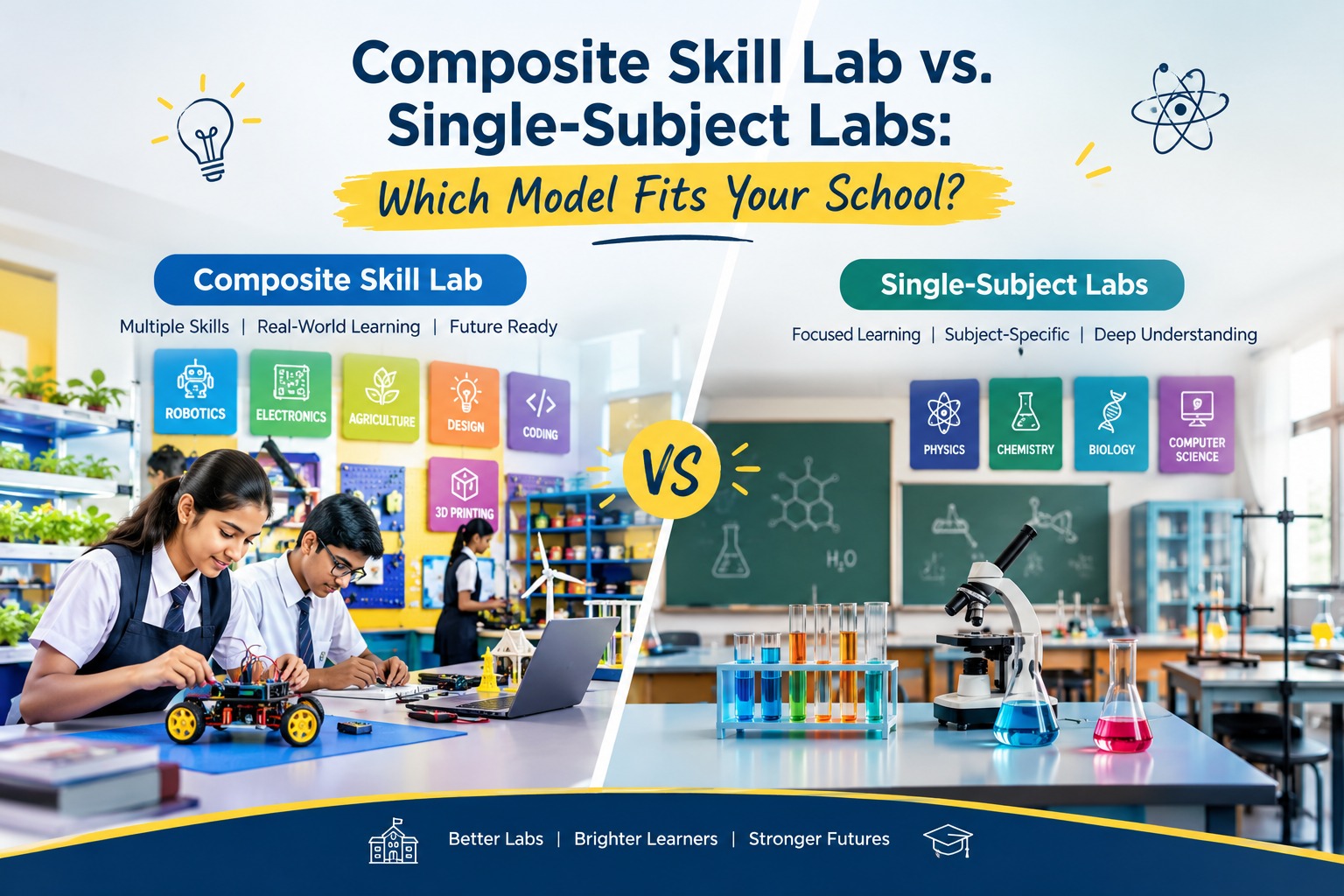
Composite Skill Lab vs Single Subject Labs: Which one is the best option for students?
School laboratories are now evolving into places where kids interact, innovate and relate class room theories into practical applications.
But while considering infrastructure planning schools are faced with a crucial dilemma of choosing between a Composite Skill Lab and individual or single subject labs.
We can help you understand the difference between Composite Skill Lab vs Single Subject Labs and also understand the factors that you need to consider while making a choice.
| Feature | Composite Skill Lab | Single-Subject Labs |
|---|---|---|
| Learning Scope | Multi-Disciplinary Robotics, AI, Electronics, Coding, Design Thinking, Agriculture, & Vocational Trades. |
Subject-Focused Dedicated syllabus focus on Physics, Chemistry, Biology, or Computer Science. |
| Infrastructure & Space | Consolidated single space (e.g., 600 sq. ft or two 400 sq. ft labs per CBSE guidelines). Highly flexible. | Requires separate dedicated rooms and specialized fixtures for each individual subject. |
| Cost Efficiency | Optimized equipment sharing, multipurpose tools, and lower recurring lab overheads. | Higher cumulative expenditure across multiple rooms, specialized glassware, and individual setups. |
| Curriculum Alignment | Aligned with NEP 2020 & CBSE circular skill-13/2026 for experiential skill education. | Aligned with traditional board exam practicals and specific theoretical coursework. |
Three Major Difference You Must Know
1. Learning Scope and Flexibility
While single subject labs focus on individual subjects like physics, chemistry, biology or computer science; composite skill labs introduce multiple skill sets and practical approaches to different fields like robotics, electronics, agriculture, design, carpentry or other vocational skills.
A composite Skill Lab v/s single subject labs offer a more flexible approach to practical learning and do not restrain a student to one subject area.
2. Infrastructure and Cost
Each single subject lab requires dedicated infrastructure and space. This can be a huge restraining force especially if the school already has an established infrastructure.
A Composite Skill Lab, on the other hand can bring more activities inside the planned space however it must be noted that a comparative cost analysis of school lab infrastructure would depend on the equipment required and other factors.
It is crucial to keep in mind the CBSE guidelines and clear the concepts of skill-based learning before selecting any STEM lab setup and school lab infrastructure.
3. Practical Learning and Skill Enhancement
While individual labs focus on practical application and specialization in a particular field; composite labs encourage multi-disciplinary applications of different subjects.
Various studies on integrated CBSE STEM education reveal that such a system can aid knowledge enhancement however the results would depend on the activities planned and the teaching methodology followed.
Science Utsav's Perspective
At Science Utsav, we look at the inside of the laboratory and not the equipment and infrastructure. We believe that with smart planning and a well thought out strategy a composite skill lab can help students explore different avenues and develop an innovative and interactive approach to practical learning.
This is particularly crucial for schools affiliated with CBSE as the CBSE circular skill-13/2026 clearly states the requirements for composite skill labs.
The document also states that a lab with an area of 600 sq. ft or two labs of 400 sq. ft each (for two different class groups) is required for a composite skill lab.
Through our comprehensive STEM Education Programs for Schools, ScienceUtsav provides turnkey assistance in curriculum mapping, educator training, and age-appropriate hands-on kits to make composite skill labs deeply engaging and compliant with the latest board mandates.
Planning a Skill or STEM Lab for Your School?
Connect with ScienceUtsav's expert academic consultants to design a compliant, future-ready lab customized for your campus infrastructure and budget.
Talk to a Lab Setup ExpertConclusion
There is no one size fits all solution to lab infrastructure planning. While single subject labs focus on a specific area composite skill labs allow for more flexibility. We hope this blog helps you in understanding the factors required to make a choice between Composite Skill Lab vs Single Subject Labs, however, ultimately it would depend on the requirements and preferences of your school and students.
FAQs
1. What is the difference between Composite Skill Lab and traditional labs in schools?
Traditional labs focus on individual subjects while Composite Skill Labs aid practical skill development in multiple fields.
2. Which lab model is suitable for CBSE schools?
Schools need to consider their needs and the infrastructure and equipment availability for their lab requirements. It is also important to keep in mind the new CBSE guidelines.
3. Can Composite Skill Labs replace Single-Subject Labs?
Both the lab models have different advantages and can be chosen depending on the school requirements.