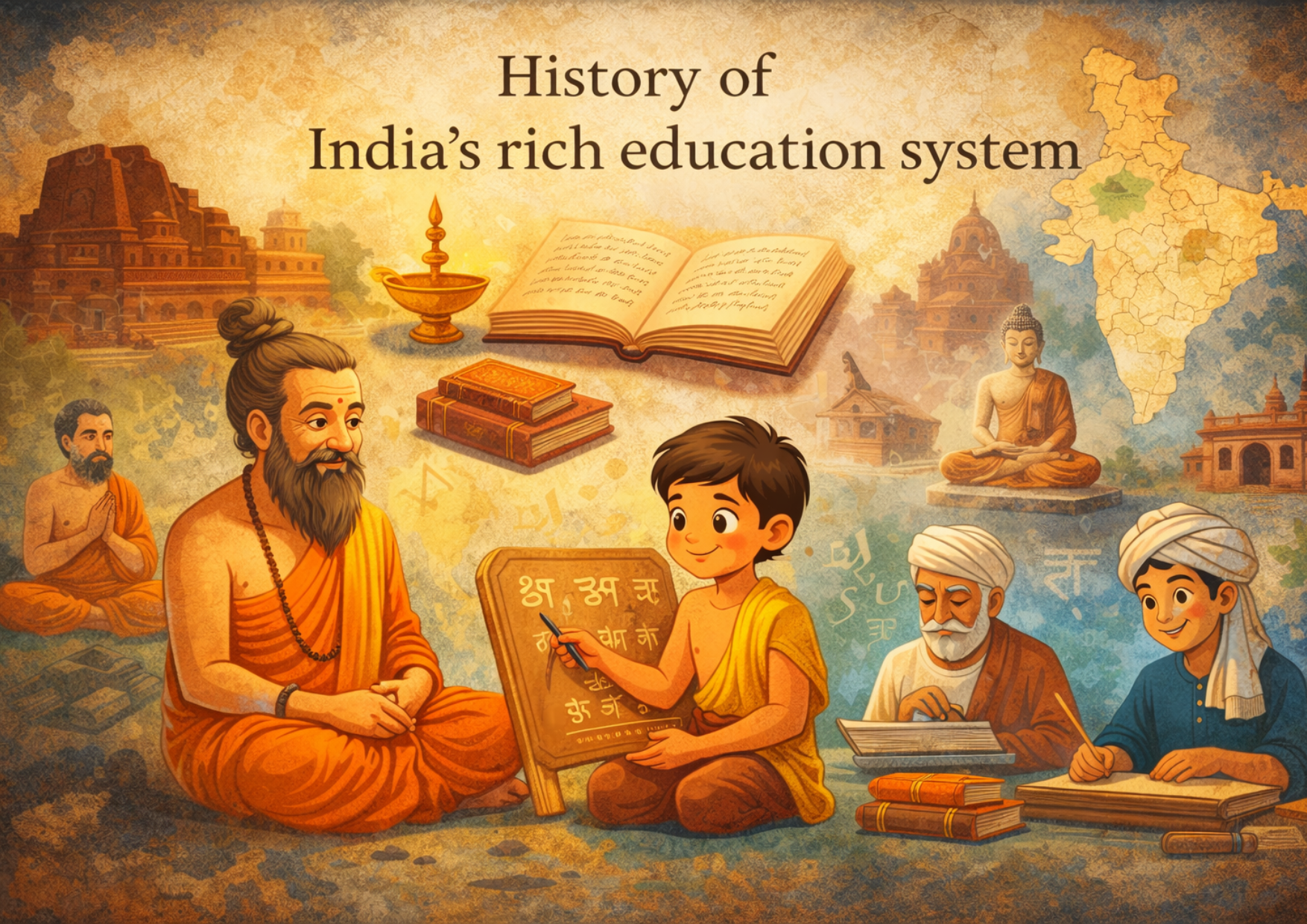
India, is well-known for its culture and traditions. Similarly, the history of education system is also rich history in its own way. In ancient times, the knowledge acquired was transformed to the next generation and it can be seen even today. As today, we don't have any formal education system in the olden days. A father pass on his knowledge to his child.
Later, they came up with two systems of education � Vedic and Buddhist. The Vedas, Vedangas and Upanishad followed the Vedic system and the Buddhist system followed the thoughts of the major Buddhist schools. Sanskrit was the language of education for the Vedic system and Pali was the language of education for the Buddhist system.
What was unique about ancient Indian education?
The education system in India in those days was unique and different when compared to others in the world. If a child wants to get education, he needs to leave his home and stay with the teacher at a gurukul for the entire duration of his studies. They charge no fee for education. Ask the needs of the students including food, clothing and housing was taken care by the teacher. Physical labour is more important in this system. Even in early days, Debates and discussions were a part of education.
When could a child start acquiring education?
As per the Vedic system, a child started can start his education at the age of five. They do the Vidyarambha ceremony, for learning alphabets for the first time. Then they left home to live with teacher to acquire their education. For this they conduct another ceremony called Upanayana.
A child started his education at the age of eight in the Buddhist system with a ceremony called Pabbajja or Prabrajya. After the ceremony, a child started to live in a monastery under the guidance of his teacher (a monk).
Methods of teaching
In those days, group teaching is quite common. Yet, teachers also teach individually for students based on their capabilities and aptitudes. Another common practice followed for imparting knowledge is Oral recitation. They also practiced through various methods like introspection, storytelling, practical study, seminars, memorization and critical analysis.
Ancient educational institutions
In ancient times, we had so many popular educational institutions as we have today. To say few, we have four institutions which were popular for its own specializations. First is The University of Nalanda, which is popular for its Catholic and cosmopolitan character and also for its department of logic. Next is the Takshasila University, was famous all over the world for its medical school and was one of the top learning centre in 6th century BC. Next is the Vallabhi, which was famous in west India. It was also a well-known for its study center that expertise in subjects like law, medicine and economics. Fourth one is the Vikramshila, which was ra reputed and esteemed institution, well-known for Tantric Buddhism.
Post-independent period
Before independence, in India, the education system is a legacy of British education along with certain influence of North-American tradition of higher education. After independence in 1947, India followed an educational system that inherited many disparities among men and women, urban and rural populations and upper and lower classes.
Schooling patterns
In India, the current structure of the education system is learning on various stages and is popularly said to be 10+2+3 pattern. Most of the Indian stated are forced to follow this from a National Policy of 1966. Here, each student start their school at the age of six and end in to secondary education after ten years of schooling and get their Secondary School Certificate.