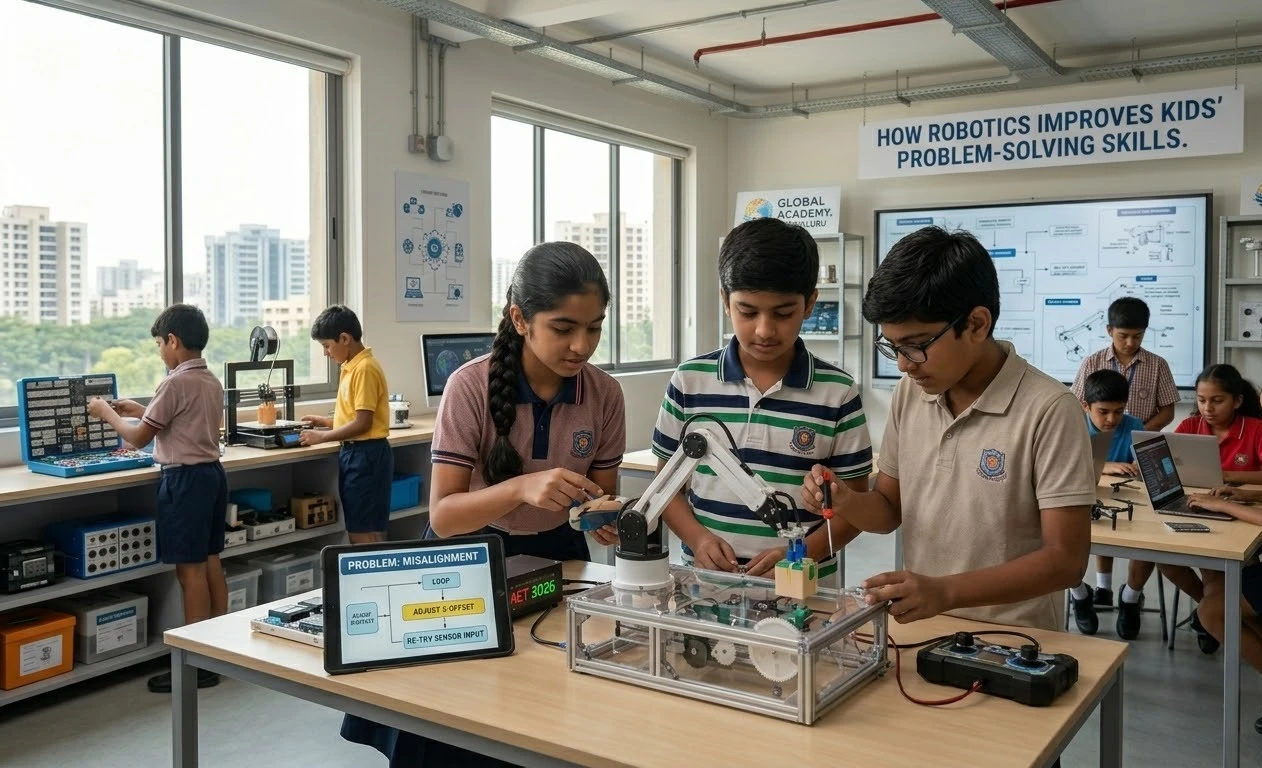
In today's rapidly changing world, children need more than just textbook knowledge. They need the ability to think, explore, experiment, and solve problems. Robotics programs provide an exciting platform where children learn these essential skills while building and programming not just robots but also microcontrollers and integrating them with input and output devices to create the desired outcomes.
Robotics combines Science, Electronics, engineering, coding, and creativity, allowing kids to transform ideas into real working machines. While it looks like play, robotics develops powerful problem-solving abilities.
1. Learning by Doing
Robotics is a hands-on learning experience. Instead of only listening to explanations, children build robots, connect components, and program them. When a robot does not move as expected, students naturally begin asking questions like: Why is the motor not rotating? Is the sensor connected correctly? Is there a mistake in the code? This process encourages curiosity and logical thinking, which are key elements of problem solving.
2. Breaking Big Problems into Smaller Steps
Robotics projects often look complicated at first. For example, building a robot that follows a line or avoids obstacles requires multiple steps. Children learn to break the challenge into smaller tasks: Building the mechanical structure, connecting motors and sensors, writing simple code, and testing the results. This method teaches structured thinking, helping kids handle complex problems step by step.
3. Learning from Mistakes
One of the most powerful lessons in robotics is that mistakes are part of learning. An IoT project you have created might not work as intended, sensors may not detect obstacles, or the program may not run correctly. Instead of feeling discouraged, children learn to test different ideas, identify errors, and improve their designs. This process builds resilience and analytical thinking.
4. Encouraging Creativity
Tech programs are not only about circuits and coding. Children also use their imagination to design unique robots and solutions. They might create a working model that cleans a table or a safety device which alarms if there is an intrusion. By combining creativity with engineering, kids learn to think innovatively when solving problems using STEM kits.
5. Building Teamwork and Communication
Tech based IoT and Automation activities are usually done in teams. Students discuss ideas, divide tasks, and help each other troubleshoot problems. Through teamwork, children learn to share ideas, listen to different perspectives, and collaborate to find solutions. These social problem-solving skills are extremely valuable in real-life situations.
6. Developing Future Skills
Robotics introduces children to technologies that are shaping the future such as Automation, Artificial Intelligence (AI), Smart machines, and the Internet of Things (IoT). By exploring these technologies early, kids develop confidence in tackling complex challenges.
Conclusion
Robotics programs do much more than teach children how to build robots. They help develop critical thinking, creativity, perseverance, and teamwork�all essential skills for solving problems in the real world. When children experiment, fail, fix, and succeed with robots, they learn an important lesson: Every problem has a solution if we keep exploring.