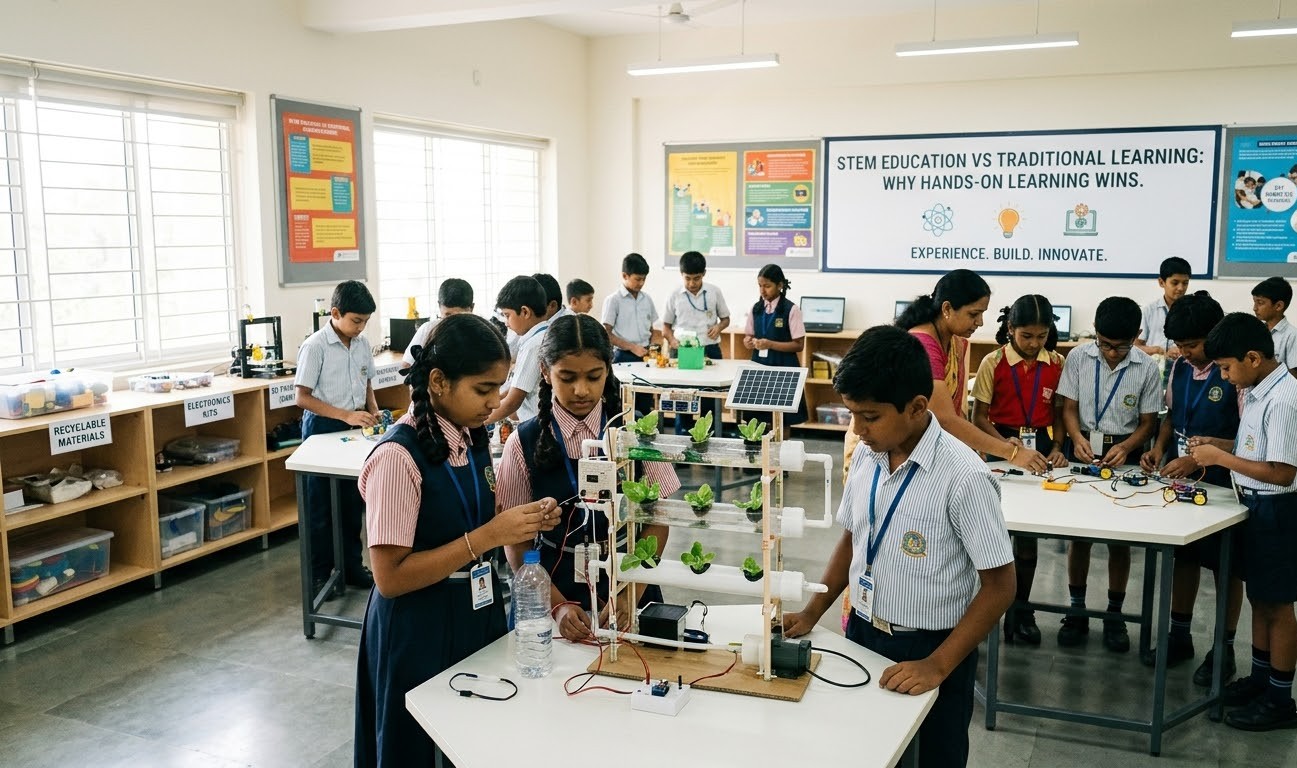
Education is evolving quickly. While traditional classroom learning focuses on textbooks, lectures, and exams, the world outside school now demands creativity, critical thinking, and practical problem-solving. This is where STEM education and hands-on learning become important.
However, even though many schools understand the importance of experiential learning, implementing it is not always easy. Schools face multiple operational, academic, and financial challenges when trying to introduce hands-on STEM programs. Understanding these challenges and addressing them with practical solutions can help schools successfully integrate STEM learning into their system.
Challenges Schools Face in Implementing Hands-On STEM Learning (and Practical Solutions)
1. Pressure for High Marks and Academic Results
Challenge: Parents often focus heavily on academic scores. Schools worry that introducing hands-on activities might reduce time for exam preparation in subjects like Science and Mathematics.
Solution: Conduct parent orientation sessions showing how STEM kits improve concept clarity, actually helping students perform better in theoretical exams.
2. Extremely Packed School Schedules
Challenge: With unit tests, Olympiads, and annual functions, classroom periods are often limited to 40 minutes, making it hard to fit experiments in.
Solution: Introduce one structured STEM period per week or integrate activities directly into existing science lessons using modular project days.
3. Fear That STEM Labs Are Too Expensive
Challenge: Administrators assume STEM labs require advanced, costly technology that parents may not want to fund.
Solution: Start with low-cost materials and basic electronics. Focus on design thinking and physics models rather than expensive high-end devices.
4. Lack of Teacher Confidence in Conducting Experiments
Challenge: Teachers trained primarily in theory may feel unsure about managing materials or troubleshooting live experiments.
Solution: Provide regular teacher training workshops and step-by-step experiment guides to build confidence.
5. Fear of Damaging Equipment or Materials
Challenge: Equipment is often kept locked away to prevent damage, leaving labs unused.
Solution: Train students on responsible usage and assign "lab roles" to encourage ownership and careful handling.
6. STEM Labs Used Only for Inaugurations
Challenge: Labs are sometimes set up mainly for photographs or special events rather than daily learning.
Solution: Schedule mandatory weekly hands-on sessions and create student innovation challenges to ensure consistent use.
7. Lack of Career Awareness Among Students
Challenge: Without exposure, science remains abstract. Students don't see the link between a classroom experiment and a future career.
Solution: Invite professionals and organize robotics and AI workshops to show real-world applications of scientific skills.
8. No Structured Program for Innovation
Challenge: Schools may do experiments but lack a framework for problem-solving.
Solution: Introduce Design Thinking workshops where students identify local problems and build simple prototypes to address them.
9. Lack of Monitoring and Sustainability
Challenge: Many initiatives fade away without proper reporting.
Solution: Establish structured activity schedules and monthly project reviews to involve school leadership in monitoring outcomes.
Conclusion: A Balanced Approach for Schools
The goal is not to replace traditional learning completely. Theoretical knowledge is the foundation. However, when theory is combined with hands-on exploration through science kits and practical projects, students gain deeper insight.
When education moves beyond memorization toward exploration, students gain the confidence needed to succeed in the world ahead. That is why hands-on STEM learning is an essential step toward preparing students for the future.