A Practical Guide for CSR Donors and NGOs Supporting Rural Education
Across India, many CSR initiatives aim to improve education in government schools. Often these efforts include donating science models such as the human brain, eye structures, digestive system charts, or plant diagrams. While these materials may look impressive when installed in classrooms, their long-term educational impact is often limited.
Students may observe these models briefly, but they rarely interact with them in meaningful ways. Over time, many such resources remain unused or locked away in cupboards. The reality is that today's students need more than static models. They need opportunities to experiment, build prototypes, think critically, and develop skills that can help them pursue meaningful careers in the future.
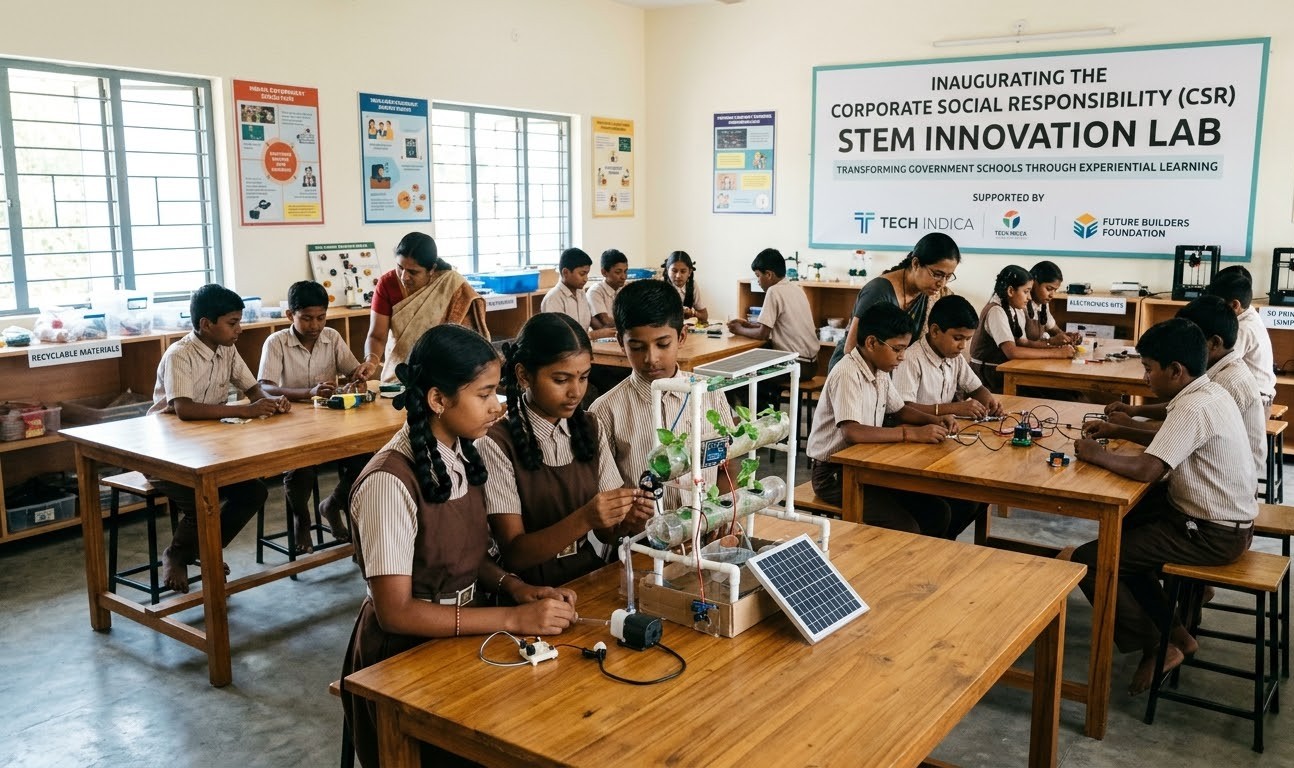
For CSR donors and NGOs, this means shifting the focus from donating materials to building learning ecosystems through STEM labs. A successful STEM initiative is not about installing a fancy lab or distributing equipment. It is about creating a living learning space where students actively explore science and technology through hands-on activities.
To design effective programs, CSR teams must first understand the challenges faced by rural schools. Many schools face limitations in teacher training for practical science. Teachers may hesitate to conduct experiments regularly because they have not received adequate hands-on training themselves. Another common issue is the creation of laboratories that are used mainly for inaugurations and photographs rather than everyday learning.
Corrective Actions CSR Programs Should Focus On
1. Organize Regular Innovation Workshops
CSR programs should organize at least three to four hands-on innovation workshops every year. These workshops can bring experts and educators to interact with students. Exposure to real-world practitioners helps students understand how science and technology are applied in everyday life.
2. Create a Competitive and Motivating Learning Environment
Students are often motivated when learning includes healthy competition. CSR initiatives can encourage schools to organize Science project competitions, innovation challenges, and Hackathons. These activities help students showcase their ideas and build confidence.
3. Train Students to Use Resources Responsibly
Providing equipment alone is not enough. Students must be trained to handle tools and maintain lab cleanliness. CSR programs should ensure that materials are provided with clear instructions and specific learning outcomes in mind.
4. Introduce Problem Discovery and Design Thinking Workshops
Rural students are surrounded by real-life challenges like water management and agriculture efficiency. CSR programs can introduce design thinking sessions where students learn to identify issues in their villages and build simple prototypes to solve them.
5. Help Students Explore Career Possibilities
STEM education should help students imagine their future careers. CSR initiatives can support activities that introduce students to fields such as engineering, environmental science, and electronics.
6. Provide Practical Skills for Prototype Building
Through project-based learning, students should gain hands-on experience with tools and STEM kits. Developing skills like model building and basic electronics assembly strengthens both confidence and technical understanding.
7. Develop Higher-Order Thinking Through Structured Workbooks
Instead of focusing only on memorization, CSR programs can introduce activity-based workbooks that guide students to analyze, evaluate, and create solutions, fostering deeper conceptual understanding.
8. Ensure Continuous Teacher Training and Support
Teacher capacity is a vital factor. CSR programs should organize regular teacher training workshops to help educators facilitate robotics and design thinking sessions confidently.
9. Establish a Structured Reporting and Monitoring System
CSR initiatives should include a clear reporting mechanism to track student participation levels, projects completed, and innovation activities organized to ensure the program remains effective.
10. Build a Sustainable STEM Ecosystem
The ultimate goal should be sustainability. Instead of one-time installations, programs should create a system where activities happen regularly and schools maintain the resources effectively through periodic mentoring sessions.
Conclusion: Transforming Rural Education Through Action
When CSR initiatives move beyond simply donating materials and instead focus on training and engagement, they create meaningful change. India's rural students have immense potential. What they need is not just access to information but opportunities to discover, build, and create.
By investing in hands-on STEM education, CSR donors empower young minds to shape their own futures and contribute to the development of their communities.