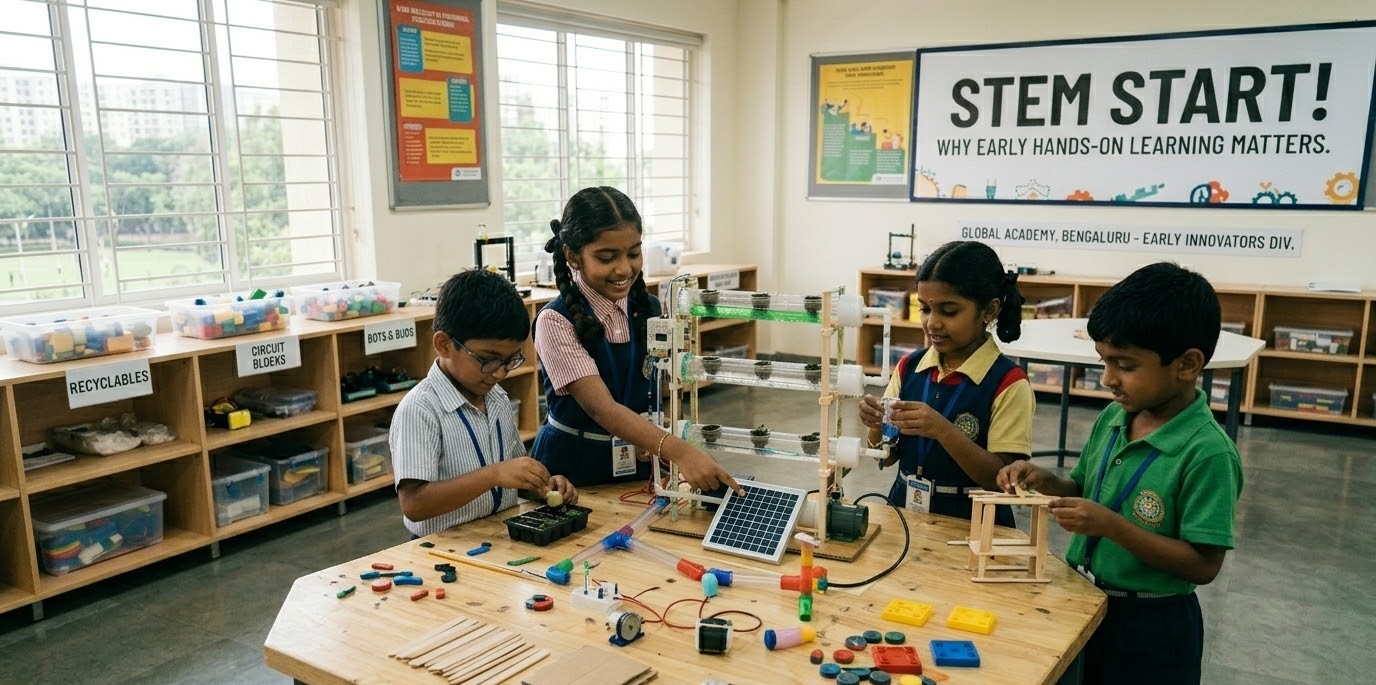
Why Curiosity-Based Learning Matters in Early Years
Children naturally learn through curiosity, exploration, and play. Before the age of 10, the brain is highly active in developing abilities related to memory, observation, creativity, and logical connections. Unfortunately, many learning environments emphasize memorizing information for exams, rather than exploring ideas and asking questions.
At this stage, children should be encouraged to ask questions, observe the world around them, experiment with simple materials, and think about why things happen. This is where hands-on STEM learning becomes very powerful.
Why Hands-On Experiments Are Important
Hands-on learning helps children experience science instead of just reading about it. When children perform small experiments, they begin to observe carefully, predict outcomes, and test ideas. They learn from mistakes and build confidence in thinking independently.
For example, when a child performs a simple experiment like a floating egg, dancing raisins, or static electricity using science kits, they naturally start asking questions such as: Why did the egg float? Why do raisins move up and down? Why does paper stick to the balloon? These questions are the starting point of scientific thinking.
Moving Beyond Rote Learning
In many classrooms today, memory is given more importance than thinking. While memory is important and develops naturally through stories and games, logical reasoning needs active experiences. Hands-on learning helps children develop critical thinking, improve observation skills, and understand cause and effect by applying knowledge to real-life situations.
The Role of Schools
Schools play an important role in creating an environment where children feel free to explore and question. Instead of focusing only on textbooks, schools can introduce simple science experiments, activity-based learning, and curiosity-driven classroom discussions. These methods make learning joyful, meaningful, and memorable.
Conclusion
The goal of early STEM education is not to push advanced technology too early, but to ignite curiosity and develop thinking skills. When children are exposed to hands-on activities and exploratory learning, they begin to see the world with wonder and curiosity. This approach helps children grow into confident learners, creative thinkers, and future problem-solvers.